Hyderabad is changing faster than ever, and that change is forcing homebuyers to rethink one of the most important real estate questions: Should I buy a home within the established city, or should I move towards the emerging outskirts? A decade ago, the answer was relatively straightforward. Today, it depends on what you value most—time, lifestyle, space, connectivity, budget, community or long-term appreciation. Hyderabad is no longer growing in one direction. It is evolving into a network of multiple residential and employment corridors, with West Hyderabad, the airport corridor, North Hyderabad, Tellapur-Kollur and the emerging Future City belt all creating their own growth stories.
Hyderabad is changing faster than ever, and that change is forcing homebuyers to rethink one of the most important real estate questions: Should I buy a home within the established city, or should I move towards the emerging outskirts? A decade ago, the answer was relatively straightforward. Today, it depends on what you value most—time, lifestyle, space, connectivity, budget, community or long-term appreciation. Hyderabad is no longer growing in one direction. It is evolving into a network of multiple residential and employment corridors, with West Hyderabad, the airport corridor, North Hyderabad, Tellapur-Kollur and the emerging Future City belt all creating their own growth stories.
For a homebuyer, this is both an opportunity and a challenge. There are more choices than ever before, but more choices also mean that simply following the latest launch, the tallest tower or the locality with the highest price appreciation may not result in the right home. A home is fundamentally different from an investment property. When you buy a home, you are buying a location where your family will spend years of its life. The distance to your workplace, children's schools, hospitals, supermarkets, social life and even your parents' home can matter more than the future price per square foot.
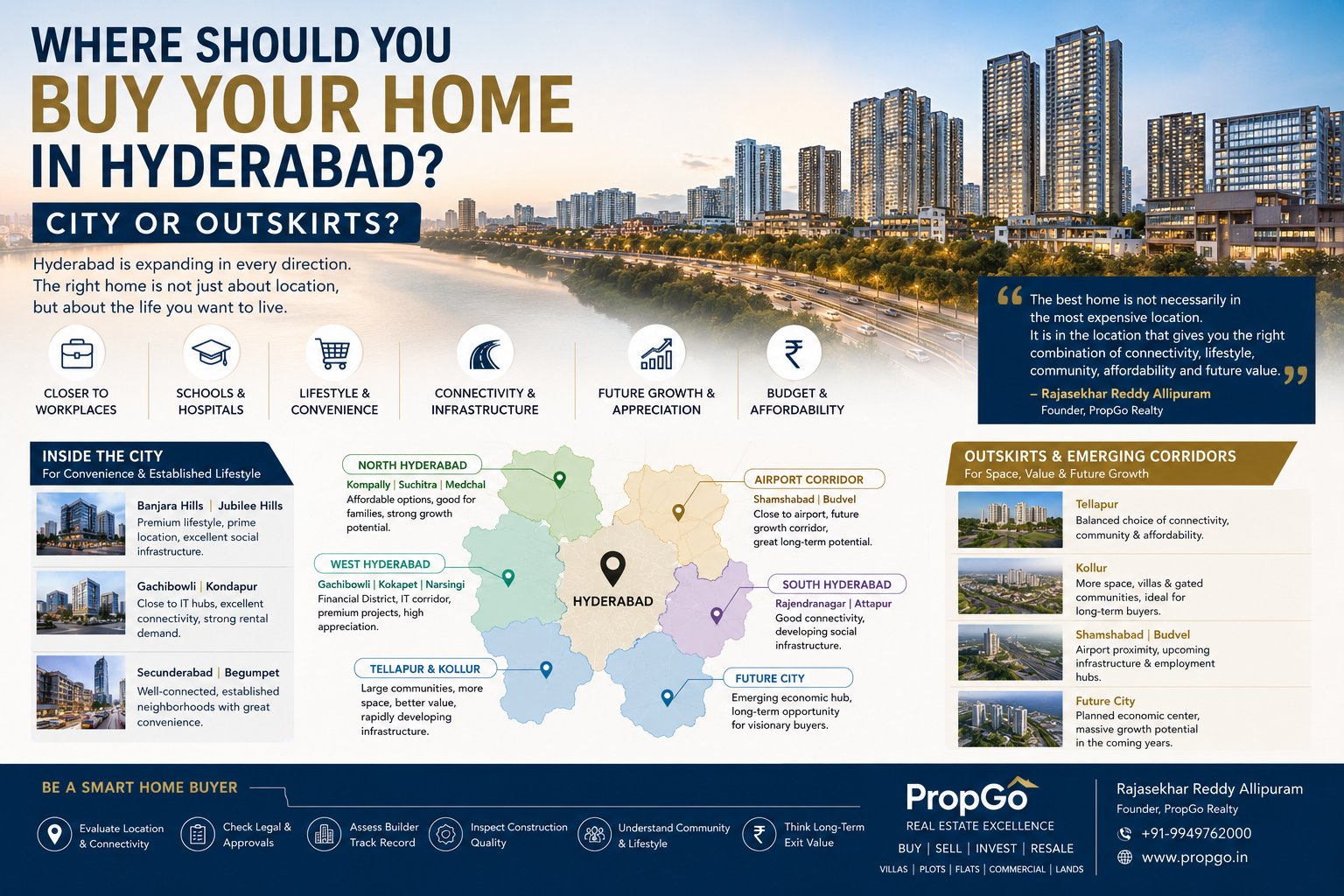
The established parts of Hyderabad continue to have one major advantage: convenience. Locations such as Banjara Hills, Jubilee Hills, Somajiguda, Begumpet, Punjagutta and other central neighborhoods offer mature infrastructure, established schools and hospitals, retail, restaurants and easy access to multiple parts of the city. The downside is equally obvious—limited land availability, higher property prices, traffic congestion and fewer opportunities to buy large homes at relatively affordable prices. For buyers who value an established lifestyle and don't want to spend years waiting for infrastructure to catch up with development, the established city still has tremendous value.
Then there is the transformation of West Hyderabad. Gachibowli, Financial District, Nanakramguda, Kokapet, Neopolis, Narsingi, Puppalaguda and the surrounding corridors have become the centre of Hyderabad's premium residential market. The biggest advantage here is the ecosystem. Employment, luxury housing, international schools, hospitals, retail and entertainment are increasingly located within the same broad geography. For professionals working in the IT and financial services sectors, living close to the workplace can significantly improve quality of life. In my view, this is one reason West Hyderabad will remain structurally important even as new growth corridors emerge elsewhere.
Kokapet and Neopolis represent the premium end of this transformation. The skyline, large-format residences, luxury amenities and proximity to the Financial District have made these locations particularly attractive to affluent homebuyers. But there is an important distinction buyers need to understand: when you buy a premium location, you are often paying for today's convenience as well as tomorrow's potential. That does not make the purchase wrong, but it means expectations about future appreciation should be realistic. Kokapet is increasingly an end-user and premium lifestyle market rather than an undiscovered location waiting to be discovered.
For many families, Tellapur may offer a more balanced proposition. It sits within the broader western growth ecosystem while offering larger residential communities and a wider range of housing options. Buyers can find apartments and gated communities that provide more space than they may be able to afford in the premium core. Tellapur's appeal is particularly strong for families who want access to the western employment corridor but don't necessarily need to live in the middle of the premium zone. The important consideration, however, is that infrastructure must be evaluated at the micro-market level. A project may be attractive on paper, but the surrounding roads, water supply, schools, healthcare and daily conveniences determine what life actually feels like after possession.
Beyond Tellapur lies Kollur, which represents a different type of opportunity. Kollur has become increasingly attractive to buyers looking for larger homes, villas and sizeable gated communities while maintaining access to the western Hyderabad growth corridor. I see Kollur more as a medium- to long-term residential story than a location where buyers should expect every urban convenience immediately. If you are buying with a five-to-ten-year horizon and want more space for your money, Kollur deserves serious consideration. If your priority is immediate convenience, an established location or a more mature western suburb may be a better choice.
Narsingi and Puppalaguda occupy an interesting middle ground. They offer proximity to Kokapet and the Financial District without necessarily carrying the same premium as the most expensive micro-markets. Their ORR connectivity and access to established western neighbourhoods make them attractive to buyers who want to stay close to the action while maintaining some flexibility on budget. These are locations where project selection becomes particularly important because two properties that appear geographically close can have very different access, infrastructure and long-term potential.
While West Hyderabad dominates much of the real estate conversation, North Hyderabad should not be ignored. Kompally, Suchitra, Medchal and surrounding areas offer a completely different residential proposition. They can make sense for families working in the northern part of the city, buyers with strong connections to Secunderabad, and those who prioritise larger homes and comparatively lower entry costs. The lesson here is simple: Hyderabad's most popular location is not necessarily the best location for you. A buyer working in North Hyderabad may be better off buying there than spending a premium to live in West Hyderabad simply because that is where the current real estate excitement is concentrated.
The southern corridor and airport region present another long-term story. Budvel, Rajendranagar, Shamshabad and surrounding areas are gaining importance as Hyderabad expands towards new economic and infrastructure zones. These locations appeal to buyers willing to take a longer view. However, there is a major difference between buying into a developing urban ecosystem and buying purely on a future promise. If you need schools, hospitals, retail and public infrastructure today, today's reality should carry more weight than a projection for 2035. If you have a longer investment horizon and can tolerate development risk, the equation becomes very different.
The emergence of Future City adds another dimension to Hyderabad's real estate map. It represents the possibility of a new economic and urban centre rather than merely another residential suburb. For investors with a long-term perspective, this could become significant. But homebuyers need to separate the idea of investing in land or property for future appreciation from buying a home for immediate family use. The two decisions should not be confused. A location can have extraordinary long-term potential and still be inconvenient for a family today.
One of the biggest mistakes I see homebuyers make is choosing a property based primarily on price per square foot. A lower price per square foot does not automatically mean a better deal. The total acquisition cost, apartment size, usable space, maintenance, amenities, location, developer quality, construction standards and future resale demand all need to be considered together. A ₹8,000-per-square-foot apartment can ultimately be a more expensive or less attractive proposition than a ₹10,000-per-square-foot apartment if the latter offers substantially better location, design, construction and resale potential.
The same logic applies to commuting. Saving ₹20 or ₹30 lakh by moving significantly farther away may look financially attractive on paper. But if that decision adds one or two hours to your daily commute, the financial calculation changes. Over several years, the lost time can be enormous. For a family, those hours could have been spent with children, parents, friends or simply resting. This is why I believe the concept of value in real estate should include time value, not just property value.
For me, the ideal home-buying decision begins with a very simple question: What kind of life do you want to live? If convenience is the priority, established neighborhoods and mature western locations make sense. If luxury and prestige are important, Kokapet and Neopolis deserve attention. If you want a balance between connectivity, community and affordability, Tellapur and selected parts of Narsingi can be compelling. If you want more space and are willing to wait for infrastructure to mature, Kollur and other emerging western corridors become interesting. If your horizon is very long, the southern growth belt and Future City deserve investigation.
But wherever you buy, due diligence should never be compromised. Check title, approvals, RERA registration, development permissions, builder track record, construction quality, water availability, access roads, maintenance costs and the actual surrounding infrastructure. Visit the location at different times of the day. Travel from the project to your workplace during peak hours. Speak to residents in completed communities. Look beyond the sales office and brochure. A property should be evaluated as a real place where you will live, not simply as a product being sold.
Ultimately, I don't believe there is one “best” location to buy a home in Hyderabad. There is only the best location for a particular buyer. The right decision for a young IT professional may be completely different from the right decision for a family with school-going children, a retired couple, an NRI looking for a second home or an investor with a ten-year horizon.
Hyderabad's growth story is creating opportunities across the city and its emerging suburbs. The smart buyer, however, should not ask only, “Where is Hyderabad growing?” The more important question is, “Where should my family live, and which part of Hyderabad gives us the best combination of lifestyle, connectivity, affordability and future value?”
That is the question I would ask before buying a home.
Because the best home is not necessarily where the property market is moving fastest. It is where your life works best.
About the Author
Rajasekhar Reddy Allipuram is the Founder of PropGo Realty, a Hyderabad-based real estate marketing and advisory firm. With extensive experience across real estate marketing, sales, property advisory and digital real estate, he works closely with homebuyers, investors, NRIs, developers and property owners across Hyderabad.
PropGo | Real Estate Excellence
BUY | SELL | INVEST | RESALE
Villas | Plots | Flats | Commercial | Lands
Rajasekhar Reddy Allipuram | Founder | PropGo | +91-9949762000 | www.propgo.in
Rajasekhar Reddy Allipuram
Founder & Managing Director, PropGo
Have questions about this market or a specific project? PropGo’s team — and a dedicated NRI desk — can give you honest, side-by-side guidance and direct-from-developer pricing.
Explore properties in this market
See PropGo’s hand-picked, RERA-verified listings — or tell us what you’re looking for and we’ll shortlist for you.